Pro Max Exteriors is an owner-led siding company serving Metro Vancouver and the Fraser Valley — James Hardie, vinyl, metal and cedar. Strong on referrals, but almost invisible online. The goal: a predictable stream of high-value quote requests, built from scratch.
Can paid ads sell $35,000 siding jobs? For Pro Max Exteriors, an owner-led Metro Vancouver siding company, deep buyer research, a conversion landing page and tracked Meta campaigns turned $2,005 of spend into 16 leads and $80,315 in signed contracts — with another $98,979 out for signature. (Google Ads had produced 0 leads first.)
Pro Max is owner-led: Max personally stands behind the quality — no anonymous crew. They had referral clients, a decent self-built website (but not optimized for search), and a Google Maps + BBB presence with a handful of reviews that even brought the odd client.
But there was almost no flow of clients from the internet. For a business doing $35,000 average jobs — up to $100,000 — that's a lot of pipeline left on the table.
The brief: research the real buyer and the BC market, build a page that earns the quote request, and find a paid channel that actually works for high-ticket siding.
Siding is a high-trust, high-ticket purchase in a market shaped by BC's leaky-condo history. The research started there: who actually buys, what they fear, and where the competition is weak.
Homeowners aren't buying siding — they're buying control, calm and predictability. The deepest fear: “I won't see the problem until it's a catastrophe — and I'll be hit with surprise charges.” The dream: get it done right once, and stop thinking about it.
Single-family house, wants to refresh the exterior but is terrified of picking the wrong contractor and blowing the budget. Buys peace of mind.
Needs documentation, discipline and a paper trail. Buys process and accountability.
Hates “free quote + pressure”. Buys honesty and zero pushiness — and walks the moment she smells a hard sell.
BC homeowners are neurotically sensitive to moisture, hidden rot and price transparency — a legacy of the 1990s leaky-condo crisis. Two trends shaped the strategy: embedded financing is now a sales standard (buyers expect a “$X/month” option, not just a total), and PE roll-ups of contractors (Renovo's collapse) have made genuinely owner-led accountability a real advantage — not just a slogan.
The market leader, Ideal Siding, runs on scale and paid traffic — but it's a franchise with no personal “face”, and a “price-match” message that repels exactly the skeptics like Emily. Pro Max's edge is the opposite: owner-led, real depth of trust, and photo evidence of every hidden layer.
Tone rules baked into everything: calm, human, specifics over hype. Banned: “limited-time deal”, “#1 in the city”, aggressive sales.
The market analysis surfaced a gap: Canada's Greener Homes Loan closed in October 2025, leaving a financing vacuum. I flagged Financeit — a major Canadian point-of-sale lender — as a strategic must. The owner learned about it from this analysis and adopted it; it's now a core objection-killer that turns “too expensive right now” into “from $X/month”. That's the kind of edge research buys, separate from the ad spend itself.
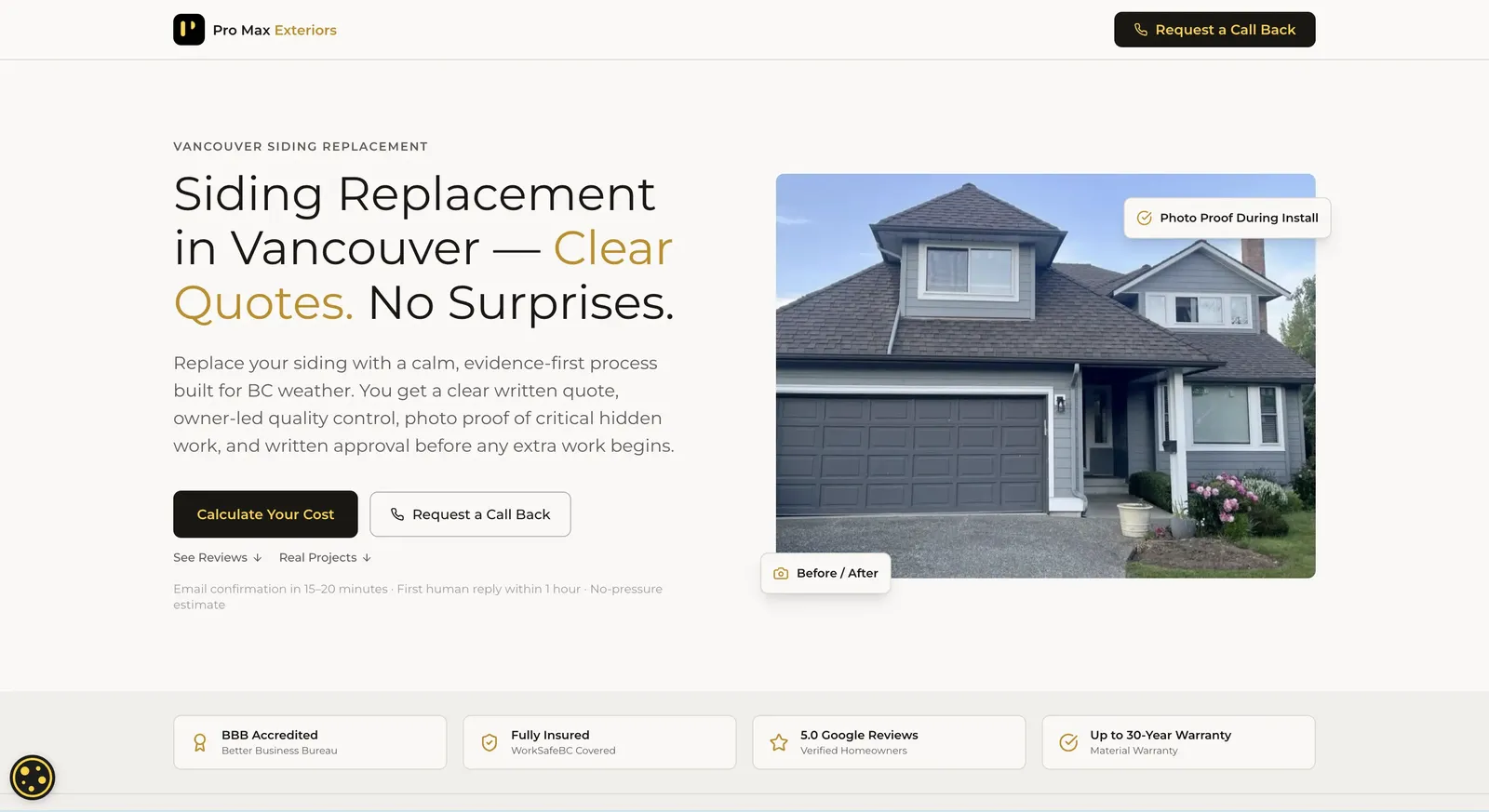
Pro Max's own site was decent but not built to convert — and not optimized for search. So I built a dedicated landing page from the research, then carried the same positioning into the main site's copy and on-page SEO.
“Owner-led siding replacement for BC homeowners — clear quote, no surprises, photo proof, no pressure.”
The single conversion goal: a free-quote request (a successfully submitted form).
The landing page and the main site are both live — judge the work yourself.
View the live landing page ↗The channel choice was a real decision, not a default. Google Ads came first — and failed: clicks for high-intent siding queries were so expensive the budget bought roughly four clicks a day. $903 spent, zero leads. So we moved the budget to Meta.
Ads carry the pipeline today; SEO builds the asset that lowers cost-per-client for years. So in parallel I rebuilt the main site's SEO page by page — from the copy to Core Web Vitals — on the same research-driven message.
<img> tags.| Homepage — Core Web Vitals | Before | After |
|---|---|---|
| Performance score | 33 | 76 |
| LCP (largest contentful paint) | 18.1s | 2.9s |
| TBT (total blocking time) | 1,450ms | 380ms |
| On-page SEO score | — | 100 |
| Metric | Result |
|---|---|
| Meta ad spend | $2,005 |
| Leads | 16 |
| Contracts signed | 4 → $80,315 |
| Out for signature | 2 → $98,979 |
| In active negotiation | 3 more homeowners |
| Google Ads (the pivot) | $903 → 0 leads |
From $2,005 of Meta spend: 16 leads, 4 signed contracts worth $80,315, two more out for signature at $98,979, and three more homeowners in negotiation. The business is loading its existing crews, about to hire a new one, and heading into a full season — the client is very happy. Google Ads, by contrast, spent $903 for zero leads; the pivot to Meta was the call that made it work.
The win wasn't a clever ad. It was understanding a moisture-anxious BC homeowner, building a page that answers every fear, choosing the channel that actually reaches them, and optimizing on real signed contracts — plus a financing call (Financeit) that the research, not the ad account, produced.